Publication
Fueling the fire: predicting cogongrass (Imperata cylindrica) impacts on fire behavior across environmental and seasonal gradients
Sep 7, 2026
Ivory II, A. A., Wonkka, C. L., McGranahan, D. A., Akpejeluh, P., Kincy, S., Weidig, N. C., Roberts, C. P., Brock, K. M., Silva, C. A. & Donovan, V. M. (2026). Fire Ecology, vol. 22, no. 1, pp. 119.
Abstract
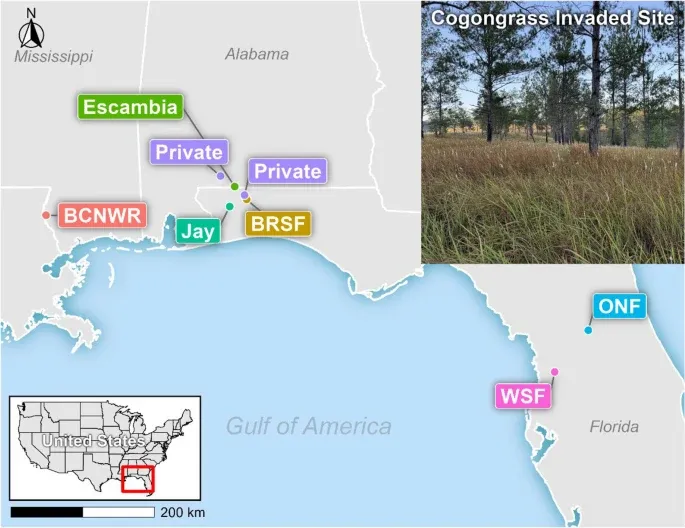
Invasive species can fundamentally alter fire regimes by modifying fuel characteristics, yet predicting their impacts on fire behavior remains challenging. Cogongrass (Imperata cylindrica), a highly invasive grass spreading across the southeastern US, has been associated with increased fuel loads and fire intensity, but it is unclear how its impacts on fuel load and fire behavior vary across environmental and seasonal gradients. We measured fuel characteristics across 159 cogongrass invaded and non-invaded plots spanning from central Florida to southern Mississippi across multiple seasons. Using these data, we developed custom fuel models in BehavePlus to predict cogongrass effects on surface fire behavior and tree torching across spatial and temporal gradients. Cogongrass invasion increased live fuel loads by up to 1.96 t/ha, with effects strongest in summer and at lower latitudes, and dead fuel loads by up to 1.88 t/ha across all sites. Latitude × invasion interactions indicated that fuel load differences between invaded and non-invaded plots diminished toward northern sites. Cogongrass-driven fuel load alterations elevated surface fire rate of spread (median + 0.75 m/min), and flame length (+ 0.16 m), with the largest increases observed in spring (rate of spread: + 2.60 m/min; flame length: + 0.80 m). Invasion also consistently increased the crown fire transition probability, with magnitudes mirroring those of surface fire effects. Our findings highlight the potential for cogongrass to substantially alter fire behavior across a range of environmental conditions, although the magnitude of these effects varies geographically and tends to be strongest at lower latitudes. These results underscore the importance of targeted management in regional fire planning of invaded landscapes.